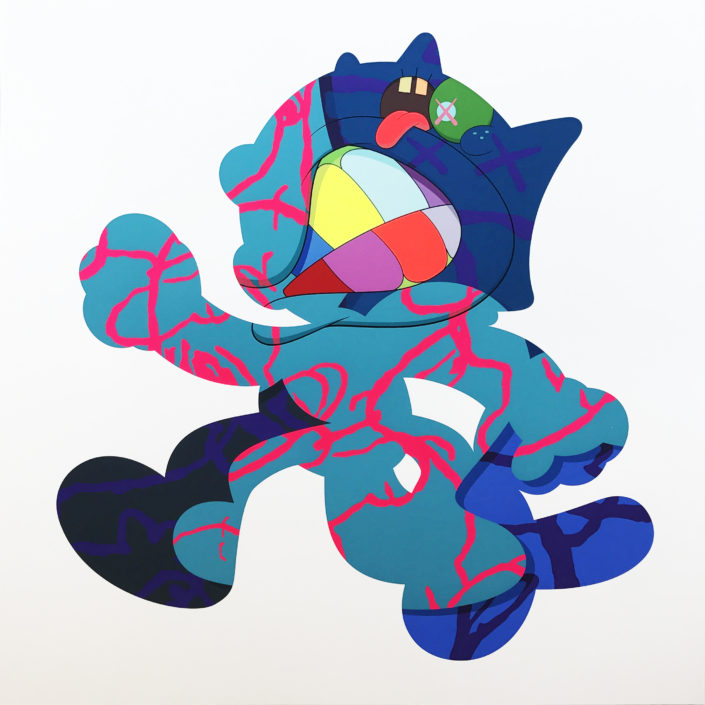
AMERICAN, b. 1974

Brian Donnelly is currently best known as the artist KAWS. KAWS is a New York-based artist who has made a name out of him designing limited edition toys and clothing. He is also a world-renowned artist who exhibits in museums and galleries internationally. His art stands somewhere between fine art and global commerce. KAWS moved beyond the sphere of the exclusive art market to occupy a more complex global market.

His cartoonish style—including his best-known characters with X-ed out eyes—has its roots in his early career as a street artist, when he began replacing advertisements with his own, masterful acrylic paintings in the early 1990s. Since, KAWS has embraced the commercialist spirit of Claes Oldenburg and Takashi Murakami, designing everything from Kanye West album covers to Nike sneakers.

KAWS Screenprints at Hamilton-Selway

Most people who call us about KAWS have already decided they want one. The questions come after that. Which print? Which edition? Is it signed, and is it the real thing?

Those are the right questions to ask. KAWS sells in more formats than almost any living artist. There are vinyl toys, open-edition posters, plush, sneakers, cereal boxes, and signed, numbered screenprints. Only the last group is what a fine art collector is buying, and from a distance they can all look alike online.

Our KAWS screenprints are signed by the artist and come from numbered editions. You can browse them above or click through to each artwork page for the full details.

Why Collectors Buy KAWS Screenprints

KAWS paintings are out of reach for most private buyers now. In April 2019, The KAWS Album sold at Sotheby’s Hong Kong for about $14.7 million, roughly fifteen times its estimate. His large canvases have traded in the millions since.

Screenprints are how most collectors bring KAWS home.

The medium suits him. Brian Donnelly trained in illustration at the School of Visual Arts and painted backgrounds for animated TV shows before the art world knew his name. His work is built from clean outlines and flat, saturated color, the same things a good silkscreen does best. A KAWS screenprint is not a weaker version of a painting. In many cases the image looks like it was always meant to be a print.

There is also the wall test. A lot of pop imagery wears thin after a few months. KAWS holds up because his figures are quietly sad. A cartoon covering its face is funny the first time you see it. After that, it starts to look like a mood.

Screenprint, Poster or Toy?

This is the first thing to sort out, because the price gap is huge.

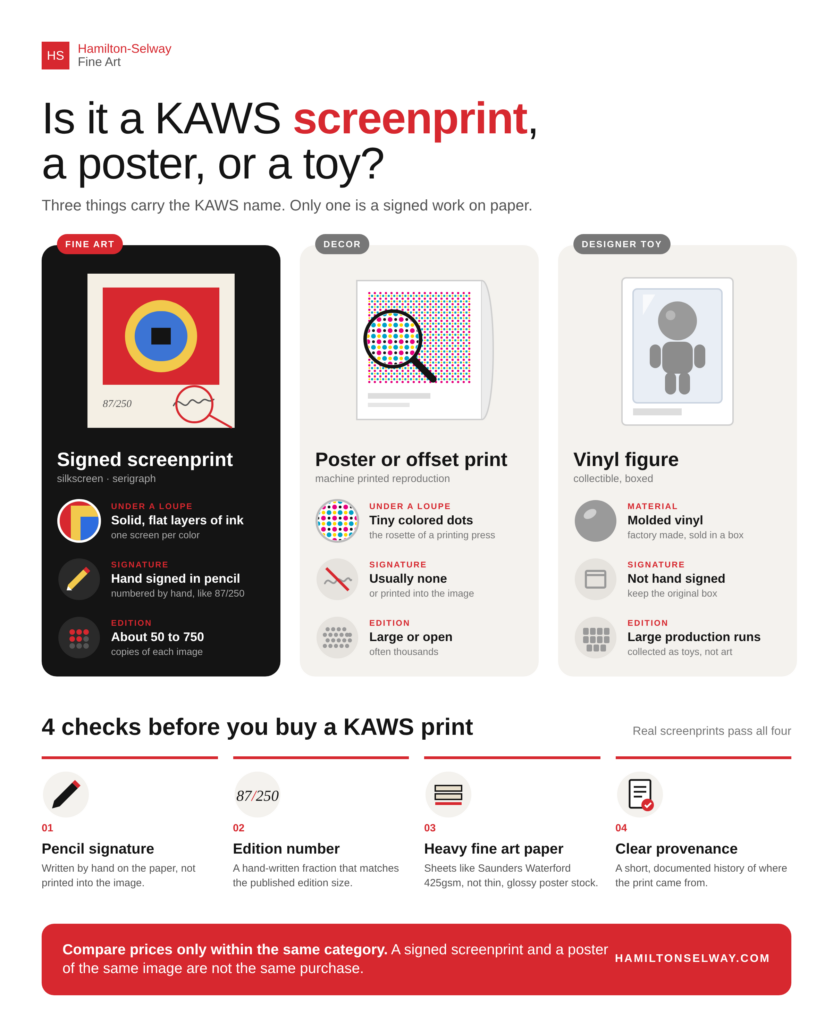
  • Signed screenprints (silkscreens or serigraphs). Printed by hand, one color layer at a time, on heavy fine art paper. Signed and numbered by KAWS, usually in pencil. Editions run from 50 to a few hundred. This is what we sell.
  • Unique collaged screenprints. One of a kind works built from screenprinted elements, like the KAWS X Brooklyn Museum pieces. Signed and dated, no edition number.
  • Posters and offset prints. Machine printed, often unsigned or in large runs. Fun to own, but a different market.
  • Vinyl figures and plush. The Companion toys that made him famous. Collected seriously, but they are designer objects, not works on paper.

If you are comparing prices you have seen elsewhere, make sure you are comparing the same category. A signed screenprint from an edition of 100 and an open-edition poster of the same image are not the same purchase.

The same questions come up with every pop artist who made prints. Our Andy Warhol screenprints collector guide covers them for Warhol.

KAWS Screenprints at Hamilton-Selway

KAWS Screenprints We Offer

Our inventory changes often, so check the artwork pages or call for what is available today. These are some of the KAWS prints collectors ask us about most.

Ankle Bracelet, 2017. Nearly five feet square and an edition of only 50. It is one of the largest and scarcest KAWS prints, and it needs a real wall.

Dissected Companion, 2006. An early print from the years he was running his OriginalFake store in Tokyo. The Companion is cut open like an anatomy chart, which is a very KAWS joke about what is inside a cartoon.

Tension, 2019. A large serigraph, 35 x 23 inches, in an edition of 100. That is a small edition for KAWS, at a size that still holds a wall on its own.

What Party – Blue, 2020. Printed on Saunders Waterford 425gsm paper in an edition of 100. The title is the same one KAWS gave his 2021 survey at the Brooklyn Museum.

Urge, 2020. Screenprints based on his pencil drawings, each in an edition of 250. The Companion is touched by cartoon hands that seem to come from outside the frame. Because the sheets are sold individually, Urge is a good entry point for a first KAWS.

SHARE, 2021, and Separated, 2020. Both are printed on Stonehenge Steel Grey paper, which gives the line work a soft, drawn feel. SHARE is an edition of 500 and Separated is 250.

Gone, 2019. The Companion carrying a limp BFF, one of the most recognizable KAWS images of the last decade. At 15 x 12 inches it suits smaller rooms.

For the stories behind his best-known paintings and the prints based on them, see our guide to the most famous KAWS artworks.

Buying KAWS Prints: What to Check

KAWS is copied constantly. Fake figures turn up on marketplaces every week, and fake “signed” prints are not far behind. None of that should put you off. It just means the print in front of you has to prove itself.

The signature and number. A genuine KAWS screenprint is hand signed, almost always in pencil, with the edition number written as a fraction, like 87/250. A printed signature, a stamp in place of a signature, or a number with no matching edition size is a red flag.

The edition size. Check it against the published size for that image. Ankle Bracelet is 50. Gone is 750. If a seller cannot tell you the edition size, they do not know enough about the print.

The paper. KAWS prints on heavy fine art papers such as Saunders Waterford 425gsm and Stonehenge 250gsm Steel Grey. Ask what it is printed on. A glossy or thin sheet is usually a poster.

Provenance. Where did the print come from? First release, a gallery, an auction? A short, clear history is worth more than a long story.

Condition. These are works on paper. Light, humidity and cheap framing damage them. Ask whether it has been framed, with what glazing, and whether it has ever been hung in direct sun. Large, flat-color prints like Ankle Bracelet show handling marks easily.

Size versus the room. The spread is wide, from an 8 inch circle to a sheet nearly five feet square. A dense, colorful KAWS needs space around it. Measure the wall before you fall for a piece.

Who is selling it. Ask a direct question about edition, paper or provenance. A vague answer tells you what you need to know.

The Story Behind KAWS

A Name That Means Nothing

Ask what KAWS stands for and you are in for a letdown. It stands for nothing.

Brian Donnelly picked the four letters as a teenager in Jersey City because he liked how they looked next to each other. He painted the name on a rooftop at 13th and Coles, right where he could see it from his high school classroom window. Every graffiti writer wants to see their name up. Few get to stare at it during math class.

Maybe that is the first clue to his whole career. KAWS has always cared more about how a thing looks than about what it is supposed to mean. Critics have spent twenty-five years trying to fill that gap for him.

The Skeleton Key

After graduating from the School of Visual Arts in 1996, Donnelly took a day job painting backgrounds at Jumbo Pictures, the studio behind Doug, Daria and Disney’s 101 Dalmatians series. By night he was doing a different kind of animation.

The story goes like this. The San Francisco graffiti artist Barry McGee gave him a key that opened the ad panels in bus shelters and phone booths. KAWS later made his own. He would pop open a shelter, slide out the poster and take it home. Then he painted his characters into the ad and put it back, as if nothing had happened.

Picture it. You are waiting for the bus, half asleep, and the model in the fashion ad is being hugged by a cartoon creature with a skull for a head.

It was vandalism with good manners. He never just tagged over the ads. He worked his figures in so cleanly that people stopped to wonder whether the brand had done it. He went on to do the same in Paris, London, Berlin and Tokyo, and he was not the only one making the street his gallery. Read how Keith Haring turned the subway into his studio, or see where KAWS fits among the street masters Basquiat, Haring and Scharf.

Mickey’s Sad Cousin

In 1999 KAWS came up with the Companion. Look at it for a second and you will see Mickey Mouse, or at least Mickey’s skeleton dressed up for Halloween. The gloves are there. The big shoes are there. The face is a skull and crossbones with two X’s where the eyes should be.

That same year the Japanese label Bounty Hunter turned it into a vinyl toy. So the character that made a New York painter famous first went on sale in Tokyo.

Mickey stands for clean, cheerful, corporate fun. The Companion is what happens after the cameras switch off. It hides its face in its hands. It slumps. It sits with its head down like it just got bad news. Without a doubt, that is why people connect with it. It is a cartoon that looks the way most of us feel on a Monday morning.

KAWS Painting — The KAWS Album, 2005

In 2005, NIGO, the founder of A Bathing Ape, commissioned a painting from his friend. KAWS took the famous Simpsons parody of the Beatles’ Sgt. Pepper’s cover and repainted it, X’ing out the eyes of every character in the crowd.

So it is a parody of a parody of an album cover. Bill Morrison, the Simpsons artist who drew the cartoon version, later called the KAWS painting a “traced interpretation” of his work. You can read that as a compliment or a jab. Probably both.

In April 2019, NIGO put the painting up for sale at Sotheby’s Hong Kong. It sold for HK$115.9 million, about $14.7 million, roughly fifteen times the estimate. That is a lot of money for cartoon characters painted over cartoon characters. It was also the clearest sign yet that buyers no longer cared where street culture ended and fine art began.

So What Is KAWS Really Painting?

KAWS rarely gives a straight answer, and maybe that is the point. His figures look like toys and feel like grief. They cover their eyes. They carry each other. They fall over. In 2018 and 2019 a giant Companion lay on its back in Seoul’s Seokchon Lake and then in Hong Kong’s Victoria Harbour, as if it had simply given up and decided to float.

Maybe he is talking about loneliness. Maybe he is talking about how much of our childhood was sold to us by companies with mascots. Maybe he just likes how a skull looks with gloves on.

Most likely it is all of the above, and he is happy to let you decide. That is what keeps people coming back to his work long after the toy hype has cooled down.

The Characters and Symbols Behind the Prints

Part of the pleasure of owning a KAWS is knowing who you are looking at. He has built a small cast of characters over 25 years, and they show up again and again across his prints.

The X Eyes

The crossed-out eyes are the first thing anyone notices. The X started as a mark in his graffiti and became his signature, turning up on eyes, hands, noses and ears. In cartoons, X eyes usually mean knocked out or dead. On a KAWS figure they read more like exhaustion, as if the character has seen too much. He has never pinned the X to one meaning, and that openness is part of why it works.

The Companion

His signature character since 1999, the gray, skull-headed cousin of Mickey Mouse. In many works the Companion covers its face with both hands, a gesture somewhere between shame, grief and needing a minute. He returns to it constantly in his prints, from Dissected Companion to Urge.

Accomplice, Chum and BFF

  • Accomplice is the Companion’s sidekick, with long rabbit ears.
  • Chum riffs on the Michelin Man, puffy and stacked.
  • BFF is a shaggy blue figure that recalls Sesame Street. In Gone, the Companion carries a limp BFF in its arms.

Borrowed Cartoons

KAWS has always worked by taking a character everyone knows and changing it just enough. The Kimpsons rework The Simpsons. His Peanuts works give Snoopy and Charlie Brown the X treatment. The KAWS Album, his auction record, reworks the famous Simpsons parody of the Beatles’ Sgt. Pepper’s cover. Familiar faces, slightly wrong, is the whole trick.

The Simpsons in particular have been remixed by pop artists for decades, as we found in The Simpsons deconstructed and turned into pop art. KAWS also shares a lot with Takashi Murakami, who blurs the line between cartoon, product and fine art just as freely. For more artists in this lane, see 6 famous artists making cartoon and comic pop art.

Hands, Bones and Cut-Away Bodies

Cartoon hands reach in from outside the frame in the Urge prints. Bones stick out of the Companion’s head. Dissected Companions open up to show organs, like a toy anatomy model. These details keep his work from ever being just cute.

We took a similar approach to Jean-Michel Basquiat’s crowns, skulls and crossed-out words in the meaning behind Basquiat’s paintings and graffiti.

Are KAWS Prints a Good Investment?

No one can promise where any market goes, and we will not pretend otherwise. What we can say is that KAWS is one of the most collected living artists in the world, with major museum shows behind him. Those include the High Museum of Art in Atlanta, the National Gallery of Victoria in Melbourne, and his 2021 survey WHAT PARTY at the Brooklyn Museum.

Print values tend to follow a few things: the image, the edition size, the condition and how often that print comes up for sale. A strong image from an edition of 50 or 100 behaves differently from one in an edition of 750. Buy the print you want to live with first. If it also holds its value, that is a bonus.

KAWS prints also sit at a very different price point than his paintings or large sculptures. That is the reason many collectors start here.

If you are new to buying art as an asset, read how beginners can invest in art like seasoned experts first.

How We Help You Choose the Right KAWS Print

Some collectors call knowing the exact print and edition they want. Others just know they want KAWS and have not decided which image speaks to them.

We are happy to have either conversation. We will tell you which pieces we think are strongest right now. We will also tell you if a print is wrong for your space or your budget, which saves everyone time.

If you are further along, tracking a specific print or comparing a price you saw somewhere else, we will go through the details with you. Edition, paper, condition, provenance. Straight answers.

Starting your first collection? Our guide to building a contemporary art collection walks through the basics.

How We Help You Choose the Right KAWS Print

Yes. Our editioned KAWS screenprints are hand signed and numbered by the artist. The unique KAWS X Brooklyn Museum and KAWS x MOCAD pieces are signed and dated rather than numbered, because each one is one of a kind.

Nothing, really. They are three names for the same process, where ink is pushed through a fine mesh screen one color at a time. You will see all three used for KAWS prints.

It depends on the print. Ankle Bracelet (2017) was an edition of 50, while Gone (2019) ran to 750. Many of his prints fall at 100 or 250.

Look for a pencil signature, an edition number that matches the published edition size, heavy fine art paper and a clear provenance. Then buy from someone who can answer specific questions about all four.

Nothing. Brian Donnelly picked the letters as a teenager because he liked how they looked together as a graffiti tag.

The X began as his graffiti mark and became his signature. It reads as knocked out or worn out, which gives his cheerful-looking characters their sadness.

Inquire About KAWS Screenprints

Looking for a specific KAWS print, want to know what is available now, or just want to talk it over before deciding? Get in touch. Good KAWS prints do not stay on the market long.

Use the inquiry form on any artwork page, email contact@hamiltonselway.com, or call 310-657-1711. To see more of his best-known work first, start with the most famous KAWS paintings, drawings and screenprints.

2020 © Copyright - Hamilton-Selway

Join Our Email List

Stay up to date on works by your favorite artists.Sign up to recieve information on news, recent ac-quisitions and more!